The Anatomy of a High-Performance Office: An Interior & Fitout Guide

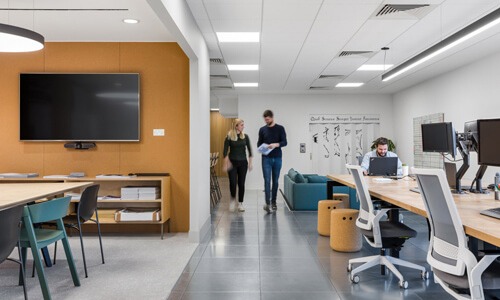
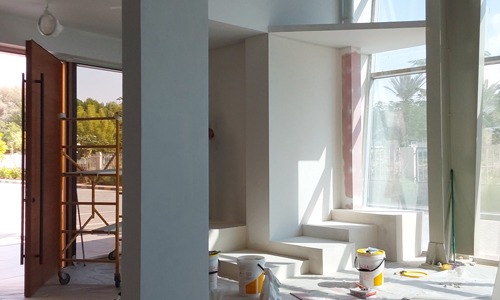
An office fitout bridges the gap between a bare concrete shell and a high-performance corporate environment. True productivity stems from how the space is built out structurally, materially, and mechanically.

Commercial Interior and Fitout

Why a Productive Workspace Matters

This guide breaks down how to execute a premium office interior and fitout designed to minimize cognitive friction and optimize daily operations.

Spatial Planning and Structural Fitout

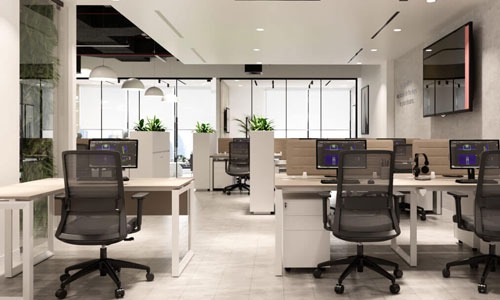
The layout of partitions and structural elements dictates the acoustic and visual flow of the workspace. A successful fitout ensures distinct functional areas co-exist without interference.

Demountable Glazed Partitions:
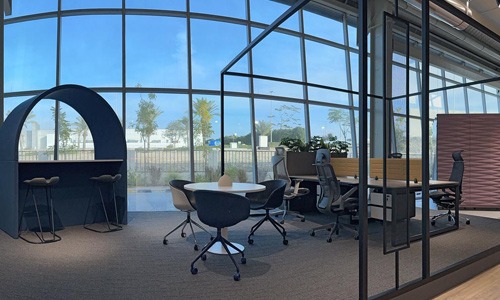
To preserve natural light penetration while maintaining acoustic privacy, specify double-glazed glass partitions for executive offices and meeting rooms. This offers high acoustic attenuation—measured as a high Sound Transmission Class (STC) rating—without creating dark, isolating cubicles.

Drywall Sub-Zoning:
Use high-performance drywall assemblies featuring internal acoustic insulation (such as rockwool) to separate high-noise areas like cafeterias or server rooms from heads-down writing and design zones.

Progressive Spatial Flow:
Arrange the floor plan so that visitors and casual traffic pass through reception, transition into collaborative lounges, and finish at deep-work zones. This ensures high-footfall areas never cross into quiet operational hubs.

Spatial Planning and Structural Fitout

MEP (Mechanical, Electrical, and Plumbing) Integration

The invisible infrastructure of a fitout power routing, data access, and climate control—is what makes a workspace truly functional.


Raised Access Flooring:
High-density workspaces require immense adaptability. Utilizing a raised access floor system allows facility managers to route electrical conduits and Cat6A data cables anywhere on the floor plate, keeping wires completely hidden beneath carpet tiles.

Desk Power Architecture:
Workstations should be specified with integrated flip-top power modules or under-desk cable baskets fed directly via vertical floor tracks or umbilical spines. This completely removes loose cords from sight and eliminates safety hazards.

Zoned HVAC and Air Quality:
Ensure the mechanical fitout includes multi-zone Variable Air Volume (VAV) systems. This allows different departments to control their climate independently, keeping temperatures stable between 21°C and 23°C (70°F–73°F). High-efficiency particulate air (HEPA) filtration should be integrated into the main ductwork to prevent the accumulation of carbon dioxide and airborne pollutants that lead to afternoon fatigue.

Joinery and Material Specification

Custom joinery and contract-grade finishes provide the tactile, premium details that elevate an environment while offering daily operational utility.


Integrated Storage Walls:
Eliminate the visual clutter of standard filing cabinets by specifying floor-to-ceiling, built-in joinery walls. These units should feature touch-latches or integrated flush pulls to maintain a clean, architectural profile.

Premium Veneers and Finishes:
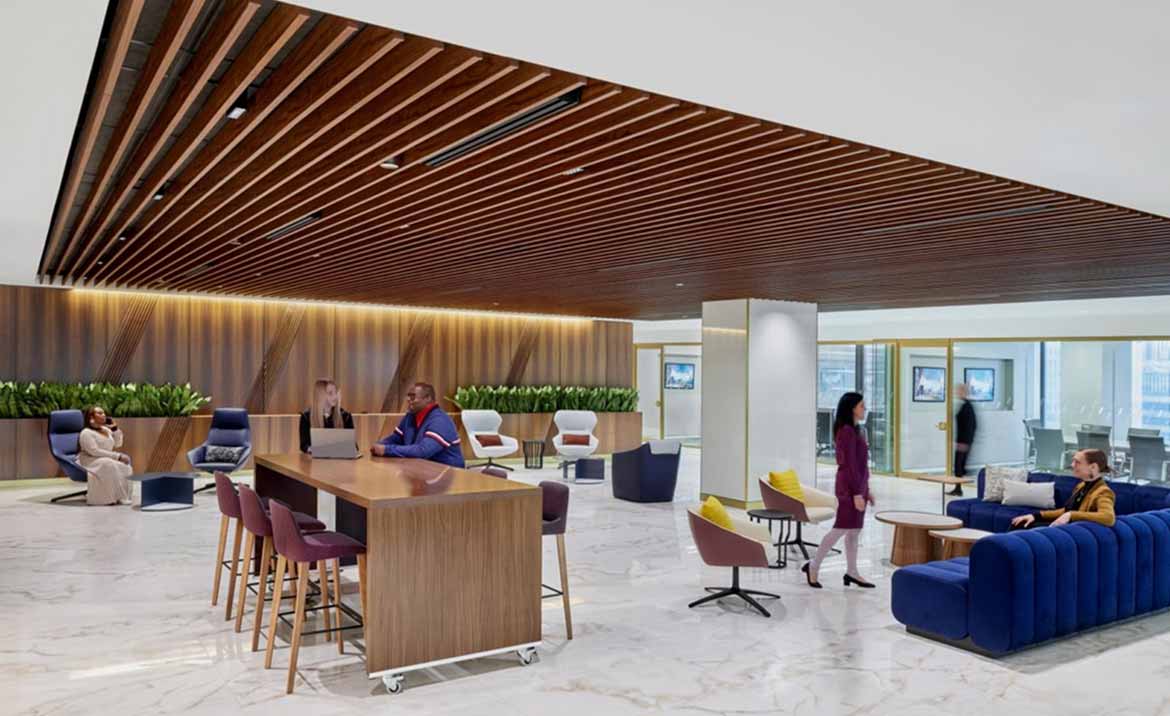
Balance sterile technology with natural elements. Incorporating premium materials like crown-cut oak veneer or walnut accents on feature walls, reception desks, and boardroom tables provides a grounding, biophilic element. Contrast these warm wood grains with crisp, sandblasted anodized aluminum trim profiles to frame glass interfaces cleanly.

High-Traffic Floor Finishes:
Specify heavy contract-grade carpet tiles (minimum 33 commercial rating) for open-plan areas to absorb footstep noise. For heavy-traffic thoroughfares and reception zones, transition to durable engineered stone or large-format matte porcelain tiles that resist wear while remaining easy to maintain.

Ceiling and Lighting Architecture

A highly productive workspace relies heavily on the design of the ceiling plane, where lighting and acoustics converge.


Acoustic Baffles and Drywall Bulkheads:
In open-plan workspaces with exposed concrete ceilings, suspend high-density polyester felt acoustic baffles directly above workstation clusters. For formal boardrooms, combine clean plasterboard bulkheads with recessed perimeter acoustic panels to ensure clear speech intelligibility during video conferences.

Architectural Lighting Tracks:
Move away from generic, high-glare grid lighting. Implement recessed or suspended black linear LED profile fixtures that provide uniform ambient illumination.

Circadian Tunable Fixtures:
Specify DALI-controlled (Digital Addressable Lighting Interface) luminaires capable of shifting color temperature throughout the day. Program the system to deliver crisp 4000K cool light during morning hours to boost focus, gradually dropping to a warmer 2700K tone in the evening to support natural circadian rhythms.

Other Articles: